LoadingPlease wait...
From agitation to administration, the unwavering voice of Telangana.
Founded by Sri K. Chandrashekar Rao (KCR) on April 27, 2001, the Bharat Rashtra Samithi (BRS), formerly the Telangana Rashtra Samithi (TRS), occupies a special place in the Indian political arena.
From agitation to administration, the BRS embodies the spirit of Telangana. From spearheading the Telangana statehood movement to creating a unique developmental model after state formation, the BRS has been the unwavering voice of Telangana, committed to safeguarding the interests of Telanganites.
Under the leadership of BRS chief and Telangana’s first CM, KCR, the party united all sections of society in a prolonged struggle for statehood.
After the formation of Telangana, through numerous innovative welfare schemes and pioneering developmental projects, the BRS government implemented a holistic, integrated, inclusive, and balanced development model.
KCR’s transformational leadership and visionary governance made Telangana a role model for the nation, achieving top rankings across sectors.
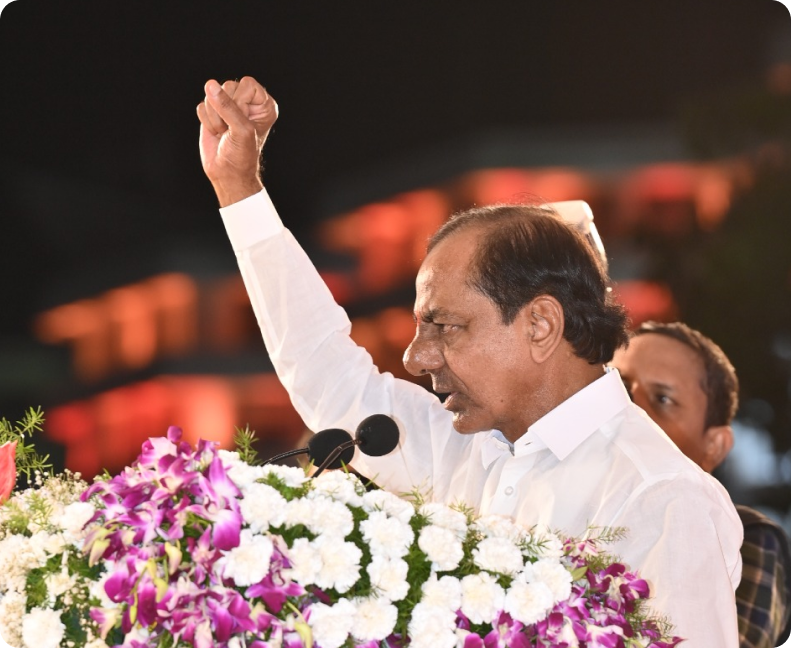
Starting his journey as a youth leader, K. Chandrashekar Rao (KCR) emerged from the grassroots, carrying firsthand experience of the issues and hardships faced by the people of Telangana.
He became a strong voice for farmers from his early days in politics, with a deep focus on rural development and the agrarian economy. He is known for his powerful oratory skills, command over multiple languages, and strong grasp of a wide range of subjects.
Before entering electoral politics, KCR served as the Chairman of the Raghavapur Primary Agriculture Cooperative Society (PACS) in Siddipet.
KCR forayed into politics in 1983 by contesting from the Siddipet Assembly constituency. Though unsuccessful in his first attempt, he went on to win the seat six consecutive times from 1985 to 2004, including the 2001 by-election that followed his resignation for the cause of Telangana after founding the Bharat Rashtra Samithi (then TRS).
From 2001 to 2014, while serving in various capacities as a Union Minister and Member of Parliament, he spearheaded the Telangana statehood movement. By uniting people across sections of society and securing the support of 32 political parties across India, he played a central role in achieving Telangana statehood.
KCR was both the force and the voice behind the Telangana movement. He led the movement peacefully to its logical conclusion and earned immense public support for his unwavering commitment to the cause of Telangana.
The people of Telangana placed their faith in KCR to govern the newly formed state and blessed him with a decisive mandate twice in the Assembly elections held after the formation of Telangana - in 2014 and again in 2018.
The Telangana statehood struggle is regarded as one of the longest people’s movements in the world. The six-decade-long struggle, which began in the early 1950s, finally attained fruition in February 2014 when Parliament passed the Andhra Pradesh Reorganisation Act, 2014.
The first major phase of the movement in the 1950s led to the constitution of the States Reorganisation Commission (SRC), which, in 1955, recommended the formation of a separate Telangana state - then known as Hyderabad State. However, intense lobbying by anti-Telangana lobby resulted in the merger of Telangana with Andhra State to form Andhra Pradesh in November 1956.
Telangana leaders, apprehensive that the Andhra region would dominate Telangana in multiple spheres, insisted on safeguards before the merger. As a result, a “Gentleman’s Agreement” was signed between leaders of both regions to protect the interests of Telangana.
Even before the ink on the Gentleman’s Agreement had dried, several safeguards and promises made to Telangana were allegedly violated. Telangana faced discrimination in budgetary allocations, while jobs and educational opportunities meant for the region were increasingly taken away.
In 1969, students and employees from the Telangana region launched a massive agitation demanding a separate Telangana state. However, the movement was suppressed by both the state and central governments, and nearly 370 youngsters lost their lives in police firing.
The continued injustice and discrimination against Telangana eventually led KCR to form the Bharat Rashtra Samithi (then TRS) in order to create political pressure on both the state and central governments for the formation of a separate Telangana state.
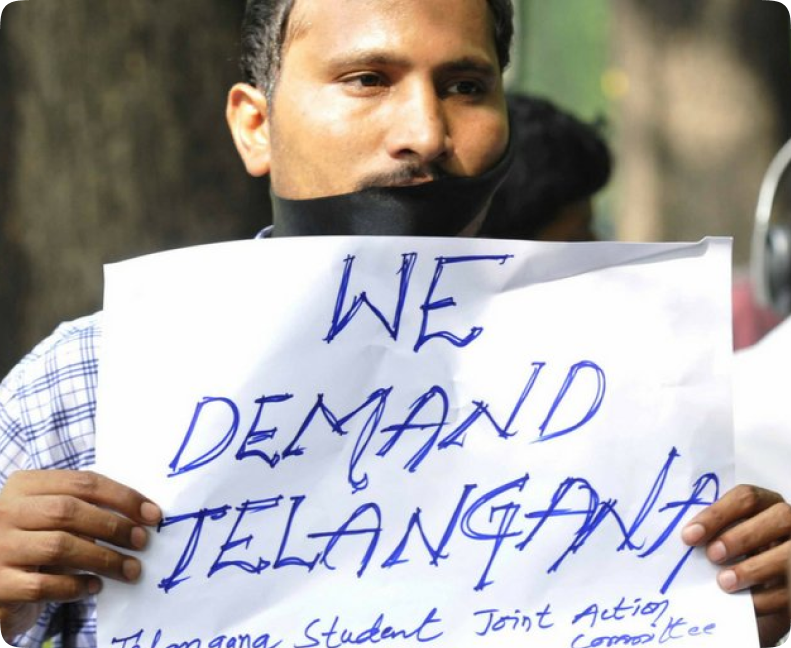
Even as the aspirations for separate statehood for Telangana continued to simmer, several people’s organisations began conducting meetings, discussions, and seminars on the issue during the 1990s.
KCR, who was then serving as the Deputy Speaker of the Andhra Pradesh Legislative Assembly, had already begun groundwork on the Telangana issue. Following extensive discussions and deliberations with Telangana intellectuals and activists, KCR resigned from the posts of Deputy Speaker and MLA, and formally announced the launch of the Bharat Rashtra Samithi (then TRS) on April 27, 2001.
Kothapalli Jayashankar (Professor Jayashankar), regarded as the ideologue of the Telangana statehood movement, extended his support to KCR. Prof. Jayashankar was a renowned educationist who served in prestigious positions, including as Vice-Chancellor of Kakatiya University and the English and Foreign Languages University (formerly CIEFL).
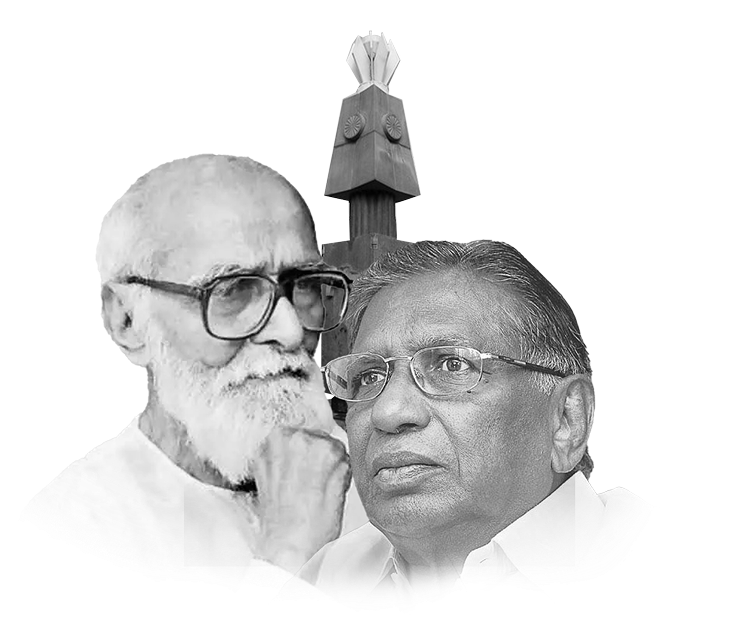
KCR used elections and by-elections as a political weapon to achieve Telangana statehood. Through a series of resignations followed by by-elections, he created sustained political pressure on both the Congress-led state and central governments. Leaders of the Bharat Rashtra Samithi (then TRS), including KCR, resigned from their positions multiple times in support of the Telangana cause.
Alongside intense political lobbying and strategic manoeuvring that eventually secured the support of 32 political parties across the country, KCR led a mass movement in various forms.
Rather than turning the issue into a mere ‘street fight’, he transformed it into a decisive ‘state fight’ rooted in democratic and political assertion. However, the movement reached its peak in November 2009.
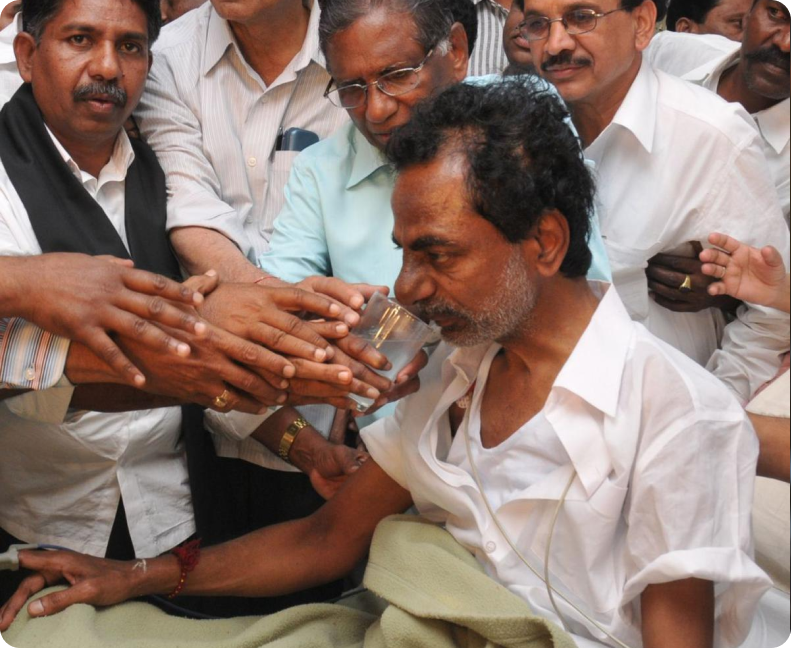
On November 29, 2009, KCR launched an indefinite hunger strike demanding statehood for Telangana. He was arrested and lodged in Khammam sub-jail. The movement spread like wildfire, with students, employees, and people’s organisations joining the agitation, bringing the entire Telangana region to a standstill.
The state government convened an all-party meeting on December 7, 2009. Leaders of the TDP and PRP assured support for a Telangana statehood resolution if it was introduced in the Assembly. As KCR’s health deteriorated, the UPA government announced on December 9, 2009, that the process for the formation of Telangana state would be initiated.
However, within weeks, intense pressure from the Anti-Telangana lobby led the UPA government to backtrack on its announcement. In response, KCR united various political and social forces in the Telangana region under the Telangana Joint Action Committee (T-JAC). TRS leaders and cadre actively participated in numerous protests and agitations organised by the T-JAC.
After four years of peaceful yet powerful protests and sustained political mobilisation, the UPA government formally initiated the statehood process in July 2013, culminating in the enactment of the Andhra Pradesh Reorganisation Act, 2014, which led to the formation of Telangana state.
The Bharat Rashtra Samithi (then TRS) emerged victorious in the first Assembly elections of the newly formed Telangana state, held in April-May 2014, by winning 63 seats in the 119-member Assembly. K. Chandrashekar Rao assumed office as the first Chief Minister of Telangana with a pledge to transform the state into a ‘Bangaru Telangana’ and make it a model state for the country.
The TRS secured a second consecutive term in 2018 with a thumping majority, winning 88 Assembly seats. The people of Telangana renewed their faith in the party after witnessing significant development and welfare initiatives during the first four-and-a-half years of its governance.
A series of welfare schemes and large-scale development programmes introduced under KCR’s leadership played a major role in the party’s resounding victory. The government focused on strengthening agriculture, irrigation, drinking water supply, infrastructure, social welfare, and rural development across Telangana.
With the objective of giving a new direction to national politics and expanding its vision beyond Telangana, KCR transformed the TRS into the Bharat Rashtra Samithi (BRS) in 2022 with a national perspective.
After completing a decade in power, the BRS won 39 seats in the 2023 Telangana Assembly elections and secured around 38 percent vote share. The party lost power by a slender margin but continued to remain a strong political force in the state.